
Picture a mid-sized online casino that launches a content push. Within three months, the team publishes sixty pages — slot reviews, payment guides, a handful of country-specific landing pages, and a glossary. Traffic barely moves. Bounce rates are high. The pages look fine on the surface, but something is wrong. What went wrong is usually the same thing: the content is technically present but functionally hollow. It answers no real question well. It borrows phrasing from competitors and adds nothing a person could actually use.
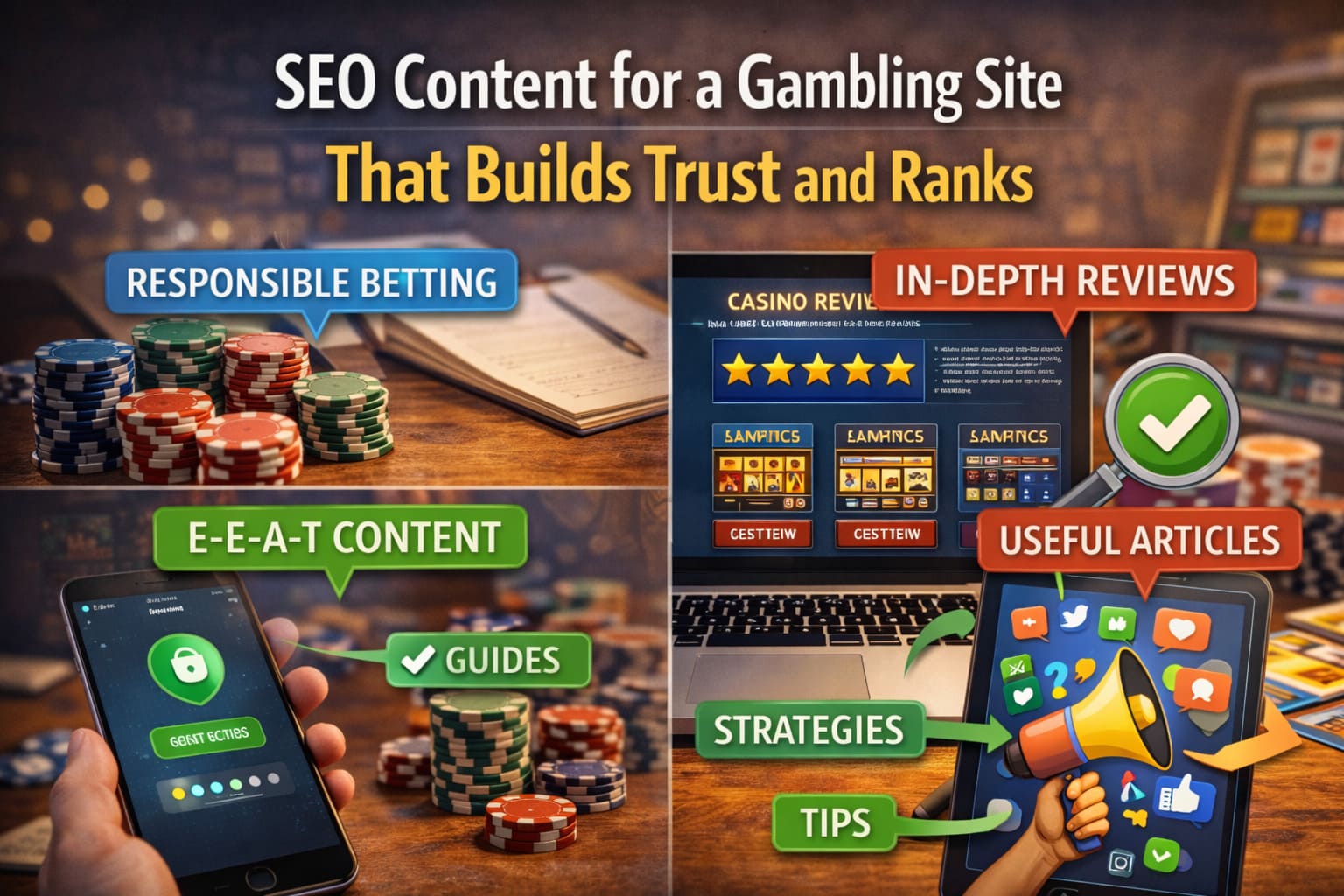
Gambling is one of the toughest niches to rank in because the obstacles stack up from every direction at once. Search engines treat it as a sensitive category, which means the bar for quality and trust signals is higher than in most industries. Regulators in different markets have rules that shape what can even be said — rules vary significantly by country and jurisdiction, so any site operating internationally needs to check local compliance guidance carefully. And users have been burned before. They have seen inflated bonus claims, misleading terms buried in fine print, and review sites that praise every casino equally. Skepticism is the default.
The core idea that holds this whole topic together is simple: helpful, credible, well-organized content ranks — and in gambling, helpful means genuinely useful to someone making a real decision, not someone being nudged toward a conversion. That distinction matters more here than almost anywhere else. Google’s own guidance around helpful content is worth reading in full for anyone building in this space, because it maps closely to what high-trust gambling content looks like in practice.
When a user searches for a specific casino name, they often land on four or five review sources in quick succession and compare them side-by-side. Sites like jackpot-jill.com show up in those comparison runs, and what users notice is whether the review answers concrete questions — withdrawal limits, verification steps, which payment methods are actually available in their country — or whether it reads like a marketing brochure. The difference is immediately felt, even if a reader couldn’t articulate exactly why.
That comparison behavior is important for content strategy. Users aren’t loyal to your site by default. They’re loyal to sites that answered their question better than the others did. Trust is earned page by page, not through branding alone. A single excellent payment-method guide can build more goodwill than a dozen thin review pages.
What follows is a grounded framework — not a list of tricks — for planning, writing, and maintaining gambling content that earns its rankings because it deserves them.
Start With Search Intent
Search intent is the real reason behind a query, and getting it wrong is expensive. A page optimized for commercial intent (comparison, decision, affiliate click) will underperform if the user is actually in informational mode — just trying to understand how something works. The reverse is equally true: a long educational explainer dropped in front of someone ready to sign up creates friction and loses the conversion.
In gambling content, these intent types mix constantly, which creates real planning challenges. A query like “best online casino UK” is clearly commercial. But “how do wagering requirements work” is informational. “Bet365 login” is navigational. Mixing intents on one page is one of the most common mistakes on gambling sites — a review page that also tries to be a how-to guide and a regulatory explainer ends up doing none of those jobs well.
Map each page type to a primary intent before writing a single word. Here are the core intents a gambling content strategy should cover:
- Navigational: users searching for a specific brand or site by name
- Informational — beginner: users learning what online gambling is, how accounts work, what KYC means
- Informational — intermediate: users understanding RTP, volatility, bonus mechanics, payout timelines
- Informational — regulatory: users asking what’s legal in their country or state
- Commercial — comparison: users choosing between two or more casinos or game types
- Commercial — review: users evaluating one specific casino before deciding
- Commercial — bonus hunting: users looking for current offers or no-deposit deals
- Transactional — payment method: users deciding how to deposit or withdraw
- Support-adjacent: users troubleshooting a problem (verification delay, withdrawal issue)
- Responsible gambling: users looking for self-exclusion tools, limits, or help resources
Build Topical Clusters
A topical cluster is a hub page with a clear focus surrounded by supporting content that covers the subtopics in depth. For gambling, this translates directly into practical architecture: a main casino review page supported by pages on payment methods, bonus terms, licensing details, mobile experience, and responsible gambling tools. Each supporting page links back to the hub, and the hub links out to the relevant subpages.
This structure helps search engines understand the relationship between pages. More importantly, it helps users navigate a complex topic without hitting dead ends. Someone who lands on a bonus page and then wants to understand withdrawal limits shouldn’t have to leave your site to find that answer.
The most common mistake with clusters is publishing hub pages without completing the supporting content. A “Payment Methods” hub that links to four placeholder pages tells search engines that the cluster is unfinished — and users notice too.
| Page Type | Main Intent | What to Include | Common Mistake |
|---|---|---|---|
| Casino Review | Commercial — evaluation | Licensing, payments, bonus terms, withdrawal speed, support quality, responsible tools | Generic praise without specific details or evidence |
| Payment Method Guide | Informational / Transactional | Fees, limits, processing time, countries supported, verification required | Copying processor’s own marketing language verbatim |
| Bonus Explainer | Informational | Clear wagering explanation, eligible games, time limits, max bet rules | Quoting T&Cs without translating them into plain language |
| Country/Region Page | Informational / Regulatory | Legal status, available platforms, payment options, local support info | Thin template with one paragraph swapped out per country |
| FAQ / Glossary | Informational | Specific, accurate answers; real definitions with examples | Vague answers that could apply to any industry |
Trust Comes Before Rankings
Trust in gambling content isn’t abstract — it shows up in measurable user behavior. Pages with clear methodology, visible author credits, and honest disclosure language get longer dwell times and lower bounce rates. Pages that lead with promotional language and bury the caveats get closed quickly.
The signals that build trust are largely the same ones that matter for long-term SEO performance in sensitive niches: transparent authorship, update dates that are current (and actually reflect real updates, not cosmetic refreshes), clear disclosure of affiliate relationships, and a responsible gambling section that isn’t an afterthought. GambleAware and similar public health resources are worth linking to genuinely, not just as a compliance checkbox.
Editorial methodology matters too. If a review site tests casinos by actually creating accounts, making deposits, running through verification, and timing withdrawals — and then documents that process — readers and search engines alike have something concrete to evaluate. A stated methodology is more convincing than any five-star rating badge.
Write Reviews People Can Actually Use
A gambling review that covers everything at the same depth covers nothing well. The sections readers actually use to make decisions are specific and practical. Licensing information tells someone whether a casino is operating legally in their country. Withdrawal speed and limits tell someone how long they’ll wait for their own money. Bonus terms tell someone whether an offer is genuinely accessible or mathematically impossible to clear.

Reviews that perform well tend to go deep on a few things rather than shallow on everything. They answer the question “would I actually recommend this to a friend in a specific situation?” rather than “can I say something positive about every feature?”
- Licensing body and jurisdiction (specific, not just “licensed”)
- Accepted payment methods with fees and limits clearly stated
- KYC and verification process — how long, what documents, any friction points
- Withdrawal speed with realistic ranges, not best-case scenarios
- Bonus terms: wagering, eligible games, max bet, time limits
- Mobile experience — native app or browser, performance, game selection
- Customer support channels and actual response time
- Responsible gambling tools: deposit limits, self-exclusion, reality checks
- Game library size and quality, including software providers
- Any known complaints or unresolved player disputes
Explain Hard Things Clearly
Wagering requirements are one of the most misunderstood concepts in online gambling, and most content makes the problem worse by either ignoring the confusion or reproducing T&C language word for word. Plain English wins every time — not because users are unsophisticated, but because jargon-heavy text is slow to read and easy to misinterpret under time pressure.

The same applies to KYC (know your customer) processes, geo-restrictions, RTP percentages, volatility ratings, and payment delays. These topics cause real user frustration, and sites that explain them well earn genuine loyalty. A user who finally understands why a withdrawal is taking longer than expected — because the verification email went to spam and the site’s FAQ explained that clearly — is far more likely to return than one who was left confused and frustrated.
| Topic | What Users Find Confusing | Better Explanation Approach | Why It Builds Trust |
|---|---|---|---|
| Wagering Requirements | 35x sounds small until you do the math | Show a worked example: £50 bonus × 35 = £1,750 to wager before withdrawal | Honesty about difficulty signals you’re not hiding the catch |
| KYC Process | When it triggers, what documents, how long | Step-by-step timeline with typical timescales and common delay reasons | Reduces frustration; user feels prepared rather than surprised |
| RTP / Volatility | What these numbers actually mean for a session | Use simple analogies; separate long-run averages from session variance | Shows editorial depth beyond surface-level slot descriptions |
| Geo-restrictions | Why a casino “available” in their country blocks deposits | Explain payment processor vs license restrictions as separate issues | Saves wasted time; builds credibility through accuracy |
Make Content Easy to Scan
High-friction niches — medical, legal, financial, gambling — share a user behavior pattern: readers scan before they commit. They’re looking for the signal that this page is worth reading in full. If the structure doesn’t deliver that signal fast, they leave.
Clear H2 and H3 headings, short summary boxes at the top of long reviews, comparison tables with verdict rows, FAQ sections that address real objections — these aren’t formatting gimmicks. They’re genuine navigation aids. A well-structured page lets someone who only wants withdrawal information skip directly to it without wading through slot library descriptions.
Update notes matter too. A visible “Last reviewed: March 2025” note with a short changelog (“Updated bonus terms after operator change”) signals that the information is current and that someone is actually maintaining it. That alone can separate a trusted resource from a stale affiliate page.
Internal Linking That Feels Helpful
Internal linking in gambling content works best when it follows the user’s natural next question. After reading a casino review, a user might want to understand one specific payment method in more depth, or check whether the bonus terms apply to their preferred games. Links placed at those natural decision points get clicked and reduce exits.

Over-linking is a real problem in this niche. Pages that turn every noun into an anchor text look manipulative — because they often are. Useful internal links go to pages that genuinely extend the current topic. A link from a bonus explainer to a full glossary of wagering terms makes sense. A link from every slot review to the homepage does not add user value.
Think about the logical progression a user might follow: landing page → specific review → payment method page → responsible gambling tools. Build links that support that journey, not links that exist only to pass equity around the site.
Freshness and Update Discipline
Gambling content expires fast. Payment processors change their terms. Casinos adjust withdrawal limits. Bonuses are updated monthly. Operators exit markets. Support contact details change. A review that was accurate a year ago may now be actively misleading — and outdated content erodes trust quickly once a user notices the discrepancy between what the page says and what the casino actually does.
Freshness isn’t about adding a sentence and updating the date. It means checking the actual source of truth — the casino’s current cashier page, terms document, and support options — and updating the content to reflect reality. Sites that do this consistently build a reputation for accuracy that compounds over time.
- A casino changes its minimum withdrawal amount
- A payment method is added or removed from the cashier
- Bonus terms are modified (wagering, eligible games, time limits)
- A new licensing jurisdiction is added or an existing license lapses
- An operator exits a specific country’s market
- Customer support hours or channels change
- A significant volume of new player complaints appears in public forums
- The operator updates its responsible gambling tools or verification process
- A new regulatory requirement takes effect in a covered jurisdiction
SEO Without Manipulation
The shortcuts that seem tempting in gambling SEO — exact-match anchor text overuse, fake urgency (“Only 3 bonuses left!”), thin country pages with swapped city names, copied bonus descriptions from affiliate feeds — have a pattern of working briefly and then failing badly. Search algorithms are increasingly effective at identifying low-effort content in high-scrutiny categories, and user trust evaporates the moment someone notices a “Limited time offer” counter that resets on refresh.
Over-optimized anchor text in internal links looks unnatural and reads poorly. Pages that describe every casino as “the best” for every type of player fail basic credibility tests. Thin city-specific pages with one paragraph of swapped content don’t help users and don’t hold rankings once they’re examined at scale.
The candid reality is that manipulation in this niche tends to be visible to the people most likely to evaluate your site — experienced gamblers who have read dozens of similar pages and know exactly what genuine analysis looks like versus what a template casino description looks like.
A Simple Editorial System
Most gambling content teams don’t fail at writing — they fail at process. Reviews go live without fact-checking. Updates get missed because nobody owns them. Style is inconsistent across pages because different writers have different habits. A simple editorial system doesn’t need to be complex to fix most of this.
A content brief that specifies the target intent, required facts to verify, word count range, and internal links needed takes twenty minutes to write and saves hours of revision. A publishing checklist that includes “verified against casino’s current terms page” catches outdated information before it goes live rather than after a reader complains.
| Workflow Step | Owner | What Gets Checked | Frequency |
|---|---|---|---|
| Content Brief | Editor / Strategist | Intent match, required facts, competitor gaps, internal link targets | Before each new page |
| Fact Verification | Writer + Editor | License status, payment details, bonus terms confirmed against source | Before publication and on update |
| Update Audit | Editor / Team Lead | Payment methods, bonuses, licensing, complaints, support info | Quarterly minimum; monthly for high-traffic pages |
| Internal Link Review | Editor | Links go to live pages, anchor text is natural, no orphan pages | On publication and after major site changes |
Metrics That Actually Matter
Pageviews tell you how much traffic arrived. They don’t tell you whether the content did its job. In gambling content, the signals that indicate genuine trust-building are more nuanced — and often more useful for diagnosing what’s working.
Click-through rate from search results reflects whether titles and descriptions match what users expect. High impressions with low CTR usually means intent mismatch. Time on page for review content is meaningful — someone who spends four minutes on a casino review read something substantial. Return visits to the same page suggest ongoing research, which is valuable in commercial niches.
- Organic CTR by page type (reviews vs guides vs FAQs tend to differ significantly)
- Average time on page for long-form review content
- Scroll depth — are users reaching the sections that matter?
- Return visitors to commercial review pages
- Low bounce rate on FAQ and explainer pages (suggests the answer satisfied the question)
- Branded search volume growth over time (indicates site reputation is building)
- Quality of conversions — not just volume, but user retention and LTV where trackable
A page with high traffic and near-zero time on page hasn’t succeeded — it’s attracted the wrong audience or failed to deliver on its title’s implicit promise. That’s more useful information than the raw traffic number.
Conclusion
The gambling sites that rank consistently over time — not just the ones that spike briefly after an aggressive link push — tend to share the same qualities: their content is specific, their methodology is visible, their facts are current, and their tone respects the reader’s intelligence. None of that requires a large team or a massive budget. It requires a commitment to being genuinely useful rather than merely present.
Trust isn’t a feature you add to a content strategy after the fact. In a niche defined by skepticism, heavy competition, and real stakes for users, trust is the strategy. Every editorial decision — how to explain a wagering requirement, whether to note a known withdrawal complaint, how recently you checked a payment method’s limits — either builds it or erodes it.
The sites that earn their rankings in gambling do so by making the reader’s decision easier, not harder.
